


Does Your Lack of a Sustainability Report Cost You Money? Access Financing and Tenders with CSRD
FINANCIACIÓN SOSTENIBLE
8/9/20253 min read


The New Reality for Your CFO: Without a Good Sustainability Report, There Is No Business
Let's be direct: until recently, sustainability was a footnote in the annual report. Today, it is a central chapter in your bank's risk assessment and in public administration tender documents. If your Chief Financial Officer (CFO) still views CSRD reporting as a mere compliance formality, they are exposing the company to two imminent financial risks: the exclusion from key contracts and an overcost in financing.
Case 1: The ESG Filter in Public Tenders
The Public Sector Contracts Law (Law 9/2017) is explicit in its Article 1 in transversally and mandatorily incorporating social and environmental criteria. This is not a recommendation; it is the law.
Practical Example: ESG Clause in a Food Sector Tender
Imagine a tender from the Health Service of an Autonomous Community to manage the catering service for its network of public hospitals for the next 5 years. A multi-million euro contract.
The technical specifications will not only evaluate nutritional quality and price, but will also include award and solvency criteria such as these:
Food Waste Reduction Plan, with verifiable metrics and annual objectives (Award Criterion: 20 points).
Percentage of local products (Km 0) and/or with ecological certification in the offered menu (Award Criterion: 15 points).
Presentation of the bidding company's latest Sustainability Report, with a specific chapter on supply chain traceability and allergen management (Technical Solvency Criterion).
Assurance (verification) of the report by an independent third party (Technical Solvency Criterion - Eliminatory).
The consequence is clear: without a verified sustainability report detailing your management of key risks for the sector (such as food safety and waste), your offer, no matter how competitive the price, will not even be considered.
Case 2: Spanish Banking Is Already in the Game
Access to capital has changed its rules. Bank risk departments, driven by the guidelines of the European Banking Authority (EBA), no longer just look at your EBITDA; they analyze your resilience to climate and social risks. Your sustainability report is the main source for that analysis.
Entities such as BBVA and Banco Santander no longer just suggest it; they structure it into their products through their Sustainable Finance Frameworks. This has created two very distinct financing lanes:
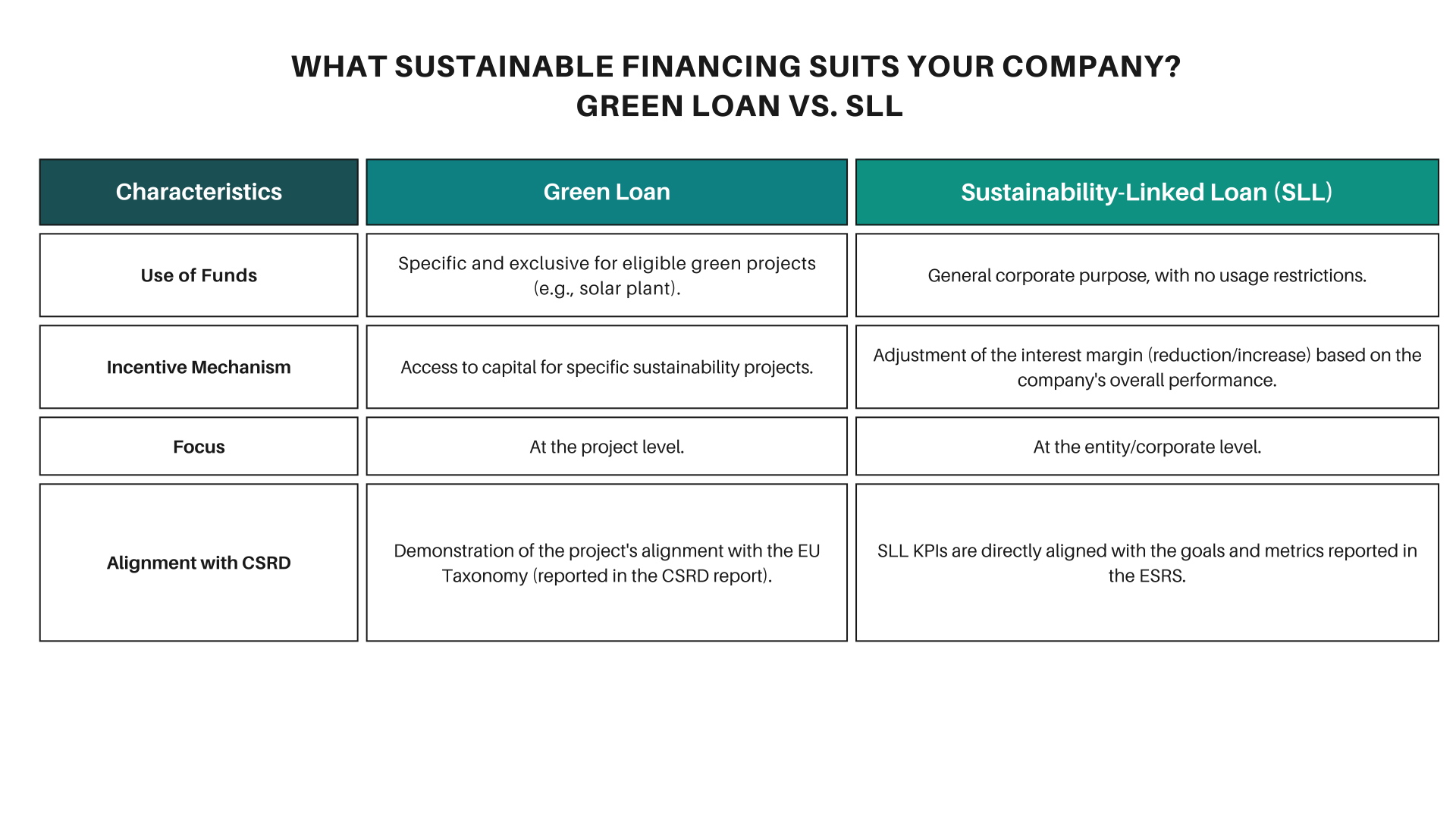
How does this translate into your bottom line?
Imagine a Sustainability-Linked Loan (SLL) for your company. If you commit to reducing your carbon footprint by 15% in two years (a KPI reported and verified in your CSRD report) and you meet it, your loan's interest rate can automatically be reduced by between 5 and 25 basis points. Conversely, if you don't meet it, you are penalized. Banks are actively incentivizing the transition, and the report is the measurement tool.
Your CSRD Report Is Your Passport to Financing and Contracts
For your report to be a business tool and not an archive document, it must be robust and credible. Banks and administrations will look at these points:
Double Materiality Analysis: This is the cornerstone. It demonstrates that you have identified and prioritized ESG risks and opportunities that have a real financial impact on your business. A superficial analysis is an immediate red flag.
Key Metrics (ESRS): They need to see data, not just narrative. Indicators such as ESRS E1 (Climate Change) or ESRS G1 (Business Conduct) are scrutinized.
Third-Party Assurance: An unverified report has near-zero credibility. Limited assurance is the minimum entry standard, and the directive already opens the door to reasonable assurance.
Quick Checklist for Your CFO: Are You Prepared?
Do we have a double materiality analysis that connects ESG risks with financial impact?
Is our sustainability report verified by an independent third party?
Can we demonstrate, with data from our report, eligibility for a "Green Loan" according to the EU Taxonomy?
Are we prepared for a major client or a tender to require our Scope 1, 2, and 3 metrics?
If the answer to any of these questions is "no" or "not sure," your ability to compete and obtain financing in the next 24 months is at risk.
This video explains how BBVA is accelerating its commitment to sustainability, which can be useful for understanding the perspective of financial institutions.
No esperes a que tu banco rechace tu solicitud de préstamo o a ser excluido de una licitación clave. Solicita aquí un Diagnóstico Rápido de Elegibilidad Gratuito y descubre si tu reporting actual te abre o te cierra puertas.
